

Every business today is talking about digital transformation.
Some are implementing ERP systems. Others are adopting AI. Many are investing in automation, analytics, dashboards, cloud platforms and mobile applications.
Yet, if you walk through many factories or warehouses, you will often find planners working in Excel, supervisors updating manual registers, approvals moving through WhatsApp, and managers chasing information over phone calls.
How can both be true? The answer is surprisingly simple.
Technology has changed. But the way the business operates often hasn’t.
The biggest misunderstanding about digital transformation is that it is primarily a technology project. But it isn’t.
It is an operating model change, enabled by technology. That distinction is far more important than it appears.
When organisations begin a digital transformation journey, the first questions are often:
-
- Which ERP should we implement?
- Should we move to the cloud?
- How do we use AI?
These are important questions. But they are not the first questions that should be asked.
A better starting point is:
“How do we want decisions to be made differently?”
Because businesses do not create value simply by installing software. They create value by making better decisions, executing processes consistently, responding faster to change, and improving customer outcomes.
Technology simply enables those capabilities.
Over the years, we have also come to look at digital transformation as an operating model transformation rather than a technology programme.
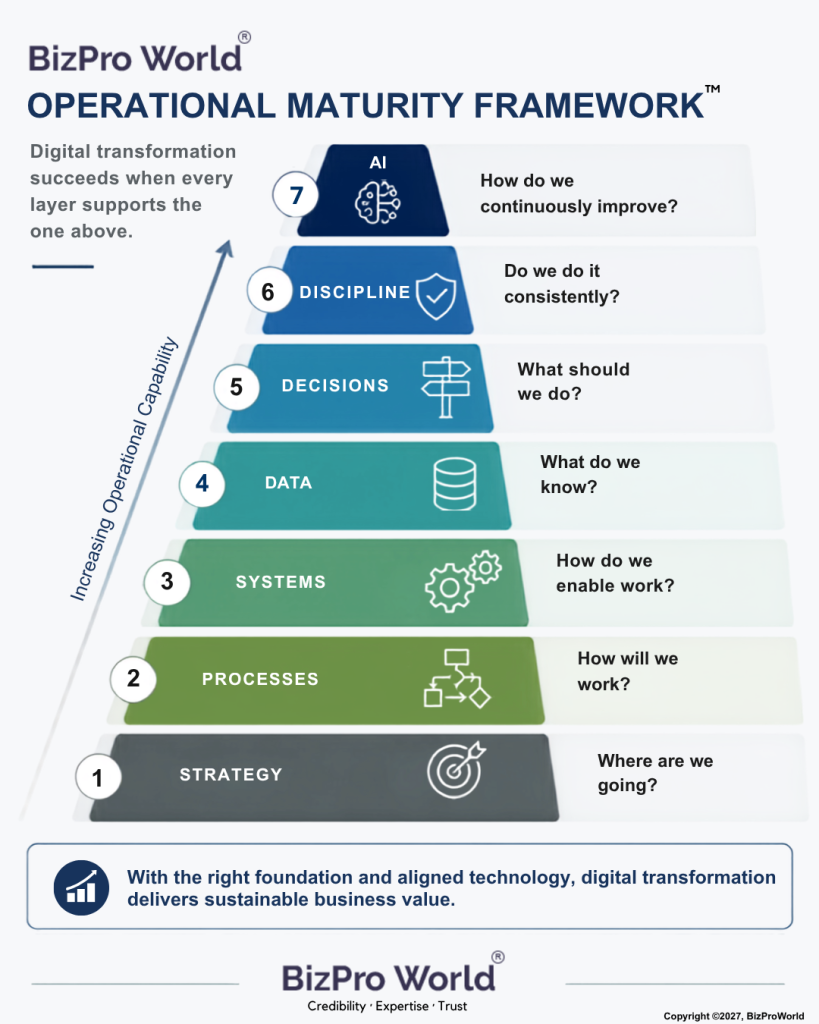
Every successful transformation strengthens seven connected layers:
Strategy → Processes → Systems → Data → Decisions → Discipline → AI
Each layer builds on the one beneath it. AI cannot compensate for weak processes. Better systems cannot overcome an unclear strategy. More data does not automatically produce better decisions.
Organisations that create lasting value strengthen each layer in sequence rather than expecting technology alone to transform the business.
That perspective has gradually evolved into our Operational Maturity Framework, shown above.
Industry studies consistently point to the rapid growth of digital and AI adoption. At the same time, many organisations continue to struggle with translating these investments into measurable business outcomes.
A 2024 RedSeer study found that 82% of SMEs recognise digitalisation as critical to business growth, yet only around 12% have achieved digital maturity. This gap reflects challenges such as fragmented processes, disconnected data, capability gaps and the difficulty of embedding new ways of working into everyday operations.
We have also often observed that organisations digitise what is easiest to standardise:
-
- Accounting
- Finance
- Compliance
- Transaction recording
- Payroll
- Basic inventory
These are essential building blocks.
But they do not necessarily improve how demand is planned, production is prioritised, procurement responds to changing requirements, warehouses execute orders, or customer commitments are managed.
That is where operational effectiveness is won or lost. This is why many organisations experience an uncomfortable contradiction. Their systems contain more information than ever before. Yet managers spend increasing amounts of time chasing information.
Dashboards exist. Reports are available.
But decisions still depend on multiple phone calls, spreadsheets, WhatsApp groups and personal follow-ups.
The issue is rarely the software. More often, digital systems have been implemented without redesigning the operating model around them.
The message is simple:
Technology adoption and business transformation are related, but they are not the same thing.
Digital transformation becomes meaningful only when it changes questions such as:
-
- Can we identify emerging problems before they become crises?
- Can we make customer commitments with greater confidence?
- Can all teams work from the same version of reality?
- Can managers spend less time collecting information and more time improving performance?
When those answers begin to change, transformation has truly started. Perhaps the next time we discuss digital transformation, the first question should not be:
“What technology do we need?”
Instead, it should be:
“How do we want this business to operate differently three years from now?”
Because once that answer is clear, the technology choices become far more obvious.
Digital transformation is undoubtedly a journey. But in today’s competitive environment, delaying that journey is becoming increasingly costly. The challenge is not simply to digitise faster; it is to build the right operating foundation so that technology creates lasting business value.
What has been the biggest lesson from your own digital transformation journey? I’d be delighted to learn from your experience.
Very Elaborate. The article talks how the mindset should happen by asking the right questions.
Asking wrong questions increases cost , hence futile investment